Among the Igbo people of southeastern Nigeria, life is not seen as a single journey that ends in death. Instead, it is a cycle — a continuous passage between the spirit world and the physical world. This belief is called Ịlọ Ụwa, meaning “coming back to the world.”
To the Igbo, existence flows like a river — birth, death, and rebirth are part of one eternal current. Through reincarnation, the ancestors live again in their descendants, ensuring that family, destiny, and spiritual legacy never fade.
🌿 What Is Ịlọ Ụwa?
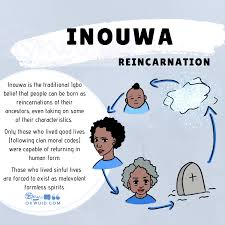
In simple terms, Ịlọ Ụwa means reincarnation — the belief that after death, a person’s soul returns to the earth in another human form.
However, in Igbo spirituality, this is not random. A soul reincarnates within its family lineage, preserving blood, name, and spirit across generations. This is why a newborn child may be said to be the “return” of a late grandfather, grandmother, or other relative.
The Igbo say:
“Ụwa bụ ụzọ.” — Life is a journey.
And every journey leads back home.
🌀 The Spiritual Logic Behind Ịlọ Ụwa
The Igbo see life as a sacred contract between Chukwu (the Supreme God), the ancestors (ndi ichie), and the individual soul (mmụọ). Before birth, every soul stands before Chukwu to choose its destiny, a purpose known as akara aka — the divine blueprint for one’s life.
After fulfilling this purpose in the physical world, the soul returns to the spirit realm to rest, review its deeds, and later, return again through birth to complete unfinished missions or deepen ancestral bonds.
In this way, Ịlọ Ụwa is not punishment, but a divine opportunity for growth, balance, and perfection.
🌳 Reincarnation Within the Family Lineage
Unlike in some Eastern religions where souls may reincarnate anywhere, in Igbo belief, Ịlọ Ụwa happens within one’s family tree.
The same ancestral line continues to host returning souls, symbolizing the continuity of life and heritage.
When a child is born, elders watch closely for signs of a returning ancestor. They may look at:
- Birthmarks or physical resemblance
- Behavioral patterns or speech traits
- Dreams or revelations from diviners
A child who strongly resembles a deceased relative in manner or spirit might be called “Nnanna” (my father again) or “Nneka” (mother is supreme). These names signify ancestral return — the rebirth of a familiar soul.
✨ Spiritual Recognition: How Ancestors Return
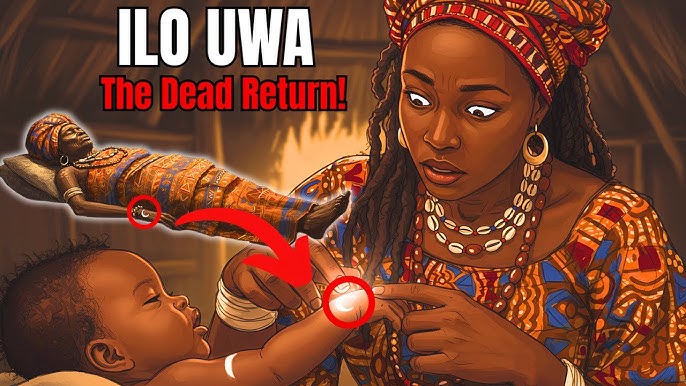
In traditional Igbo cosmology, the boundary between the living and the dead is porous, not permanent.
The living communicate with the dead through dreams, divination, and ritual. In some cases, a spirit may even announce its return before reincarnating — appearing to a pregnant mother in a dream, saying, “I am coming back.”
The newborn child is thus welcomed not as a stranger but as a homecoming soul, a continuation of an eternal family story.
⚖️ Moral Implications of Ịlọ Ụwa
Ịlọ Ụwa reinforces moral accountability in Igbo culture. Since one’s soul returns to the same world and family, every action in life carries long-term consequences.
Those who live righteously are believed to return into peaceful, prosperous lineages, while those who live wickedly may return into suffering or hardship until balance is restored.
This is captured in the saying:
“Ihe onye mere, ọ ga-ahu ya.”
(Whatever a person does, they will meet it again.)
It reflects a deep spiritual justice — a belief that the universe is not cruel but perfectly balanced through time.
🔮 Diviners and the Mystery of Ịlọ Ụwa
When uncertainty arises about who a child may have been in a past life, the dibịa afa (diviner) is consulted. Through spiritual sight, the dibịa identifies:
- The ancestor who reincarnated
- The mission or lesson the soul brings
- Any unfulfilled vows or ancestral taboos
These revelations help families maintain spiritual harmony, ensuring that both the living and the ancestors remain at peace.
🕊️ Ịlọ Ụwa and Chi: The Role of the Personal Spirit
Every person in Igbo belief has a Chi — a personal spirit or divine spark assigned by Chukwu.
Your Chi shapes your destiny, supports your mission, and connects you to the spiritual world. Even through reincarnation, your Chi remains constant, though your human experiences change.
This means that each life is another chapter in the same soul’s journey — guided by the same inner divine companion.
🌺 Ịlọ Ụwa and Naming Practices
Igbo names often reflect this deep spiritual understanding. Some names directly reference rebirth or continuity, such as:
- Nnanna – My father has returned
- Nnenna / Nneka – My mother has returned / Mother is supreme
- Mmadụka – Human life is greater
- Nwakaego – A child is worth more than wealth
Such names are not chosen randomly. They carry ancestral recognition and spiritual respect — an acknowledgment that life is eternal.
🪶 The Purpose of Reincarnation in Igbo Belief
Ịlọ Ụwa serves multiple spiritual purposes:
- Ancestral Continuity: The ancestors remain present through new births.
- Moral Balance: Souls correct past mistakes and learn new lessons.
- Family Unity: It strengthens kinship bonds across generations.
- Spiritual Progress: Each return brings greater wisdom and understanding.
Ultimately, the cycle of birth and rebirth teaches that existence is eternal, and that life — no matter how brief — always contributes to a greater cosmic balance.
🌞 Reincarnation and Modern Igbo Thought
Even in today’s Christianized or urban Igboland, many still hold quiet belief in Ịlọ Ụwa.
It coexists with modern religion as a symbol of continuity and divine mystery.
Families still identify children as reincarnations of loved ones, and dreams of ancestors returning remain deeply respected.
This blending of ancient spirituality and modern faith shows that Igbo cosmology is not extinct — it simply evolves with time, carrying ancestral wisdom into new generations.
🌺 Ịlọ Ụwa as a Philosophy of Life
At its heart, Ịlọ Ụwa teaches that:
- We are never truly gone.
- Our actions echo through time.
- Life is a sacred cycle of purpose and return.
It reminds every Igbo person that existence is not measured in years, but in spiritual growth and ancestral legacy.
To live well is to prepare for one’s next return — to leave behind peace, love, and honor that the soul can proudly carry into another life.
🌿 Conclusion: The Eternal Dance of Souls
Ịlọ Ụwa is more than a belief; it is the rhythm of Igbo spirituality — the eternal dance between the living, the dead, and the unborn. It honors the sacred truth that we are all ancestors in training, shaping the future even as we live the present.
In every newborn cry, the ancestors whisper:
“I have come again.”