Among the Igbo people of southeastern Nigeria, the word “Chi” carries a depth of meaning that transcends religion or language.
It is not easily translated, yet it touches every aspect of life — identity, purpose, destiny, and divine guidance.
To say “Onye nwere chi ya” means “Everyone has their personal god or destiny.” This single statement captures the essence of Igbo spirituality: each person is born with a unique portion of the divine — their Chi — which guides them through life’s journey.
Chi is more than a guardian spirit. It is your personal divinity, your inner connection to Chukwu (the Supreme Being), and your spiritual identity in the universe.
The Meaning of Chi
The Igbo word Chi comes from the root “Chi” or “Chineke,” meaning God, the Creator, or Spirit.
But when used personally — my Chi (Chi m) — it refers to the individualized aspect of God that lives within each person.
“Chi bụ onye ndu mmadụ n’ụwa.”
Chi is a person’s guide in the world.
Chi is therefore both a spark of Chukwu and a companion of destiny. It shapes one’s fortune, challenges, and achievements. No two people share the same Chi — each is distinct, eternal, and bound to one soul.
Origins in Igbo Cosmology
In Igbo cosmology, Chukwu (the Supreme God) is pure spirit — too great to deal directly with human affairs. Therefore, each person is given a Chi at birth, a divine delegate of Chukwu, who acts as the link between the human and spiritual realms.
This concept mirrors the Igbo understanding of balance between the visible and invisible worlds — Uwa (the material world) and Ụwa Mmụọ (the spiritual world).
Your Chi exists in both, guiding you from one life to the next, ensuring your spiritual purpose unfolds in divine time.
The Role of Chi in Destiny (Akara Aka)
Every Igbo person is believed to have a destiny (akara aka) chosen before birth in the presence of Chukwu. This destiny is recorded and protected by one’s Chi.
Chi acts as:
- The keeper of your destiny
- The negotiator of your life’s path
- The interpreter of your divine purpose
If a person succeeds, it is often said:
“Chi ya nyere ya aka.” — His or her Chi helped them.
Likewise, if one struggles, it might be said:
“Chi ya esoghị ya.” — His or her Chi did not follow.
This doesn’t imply punishment or luck — it reflects the Igbo belief that harmony with your Chi brings success, while disconnection brings confusion or delay.
Chi and Free Will
The Igbo do not see Chi as a puppet master. Instead, it’s a co-creator — your spiritual partner in shaping destiny.
You still have free will, but your choices either align with your Chi’s direction or resist it.
Living in tune with your Chi means:
- Listening to intuition
- Acting with moral integrity (ịma mma)
- Honoring your spiritual path
- Recognizing signs from the universe or ancestors (ndi ichie)
When you act in harmony with your Chi, your life flows naturally — opportunities align, and obstacles become teachers rather than enemies.
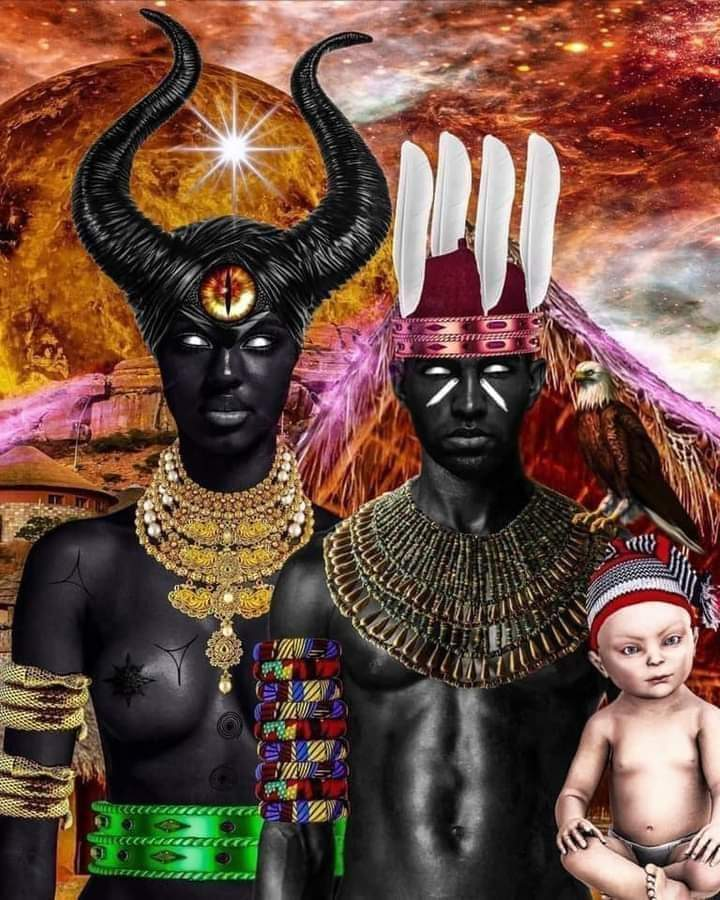
Chi and the Supreme God (Chukwu)
In Igbo spirituality, Chi is not separate from Chukwu — it is a personal reflection of the Supreme Being.
Chukwu, meaning “the Great Source,” expresses itself in every living being through Chi.
This creates a divine connection between individuals and the universe, without the need for intermediaries or strict dogma.
It’s said:
“Chi bụ Chukwu n’ime mmadụ.”
Chi is God within man.
This mirrors other world philosophies — like the Christian idea of the Holy Spirit, or the Hindu concept of Atman (the divine self).
But in Igbo thought, Chi remains personalized and relational — a spirit that knows you, walks with you, and celebrates or mourns with you.
Chi and Reincarnation (Ịlọ Ụwa)
The Igbo believe in reincarnation, the return of the soul into the lineage.
When a child is born, diviners may say the child is onye ilọ uwa — “one who has come back.”
In this belief, your Chi continues its journey across lifetimes, helping you complete unfinished purposes and refine your soul through experience.
Thus, Chi is eternal, even as the body changes.
Your Chi connects your past, present, and future selves — ensuring continuity between generations.
Chi in Everyday Life
The idea of Chi isn’t just spiritual; it shapes daily Igbo expressions, prayers, and decisions.
- “Chukwu gozie gị.” – May God bless you.
- “Chi m ekele m gị.” – My Chi, I thank you.
- “Chi ọma.” – Good destiny / good fortune.
Morning prayers often include gratitude to one’s Chi, seeking guidance for the day.
Before major decisions — starting a journey, planting crops, or negotiating — people pause to “consult their Chi,” either silently or through ritual.
Chi and Personal Responsibility
While the Chi is divine, the Igbo also teach personal accountability.
You can’t blame fate alone; your actions, discipline, and relationships influence how your Chi manifests your destiny.
A popular proverb reminds us:
“Onye kwe, Chi ya ekwe.”
When one says yes, their Chi says yes also.
This means determination activates divine support. Your Chi aligns with your conviction. In essence, faith and effort unlock your destiny.
Rituals and Symbolism
In traditional Igbo society, people often had personal shrines or sacred spaces called ọfọ na ogu, where they communed with their Chi.
Offerings like kola nut (ọjị), alligator pepper (ose oji), and palm wine (mmanya ngwo) were used to honor the Chi and ask for clarity or strength.
Although modern Igbo life has evolved, the symbolism remains powerful:
- Lighting a candle for guidance.
- Pouring libation in remembrance.
- Speaking affirmations to align with purpose.
All these are modern echoes of an ancient practice — communing with Chi, your inner divinity.
Chi in Modern Context
Today, Chi is not limited to traditional religion. It’s a philosophical idea embraced by scholars, writers, and spiritual thinkers.
Famed novelist Chinua Achebe wrote deeply about it, describing Chi as a person’s “other identity in the spirit land.”
He noted, “When a man says yes, his Chi says yes also.” — a line that’s become one of the most quoted proverbs in African literature.
For young Africans navigating modern life, the concept of Chi remains relevant.
It teaches self-awareness, faith in destiny, and spiritual independence — a reminder that your purpose is not random, but divinely authored.
The Philosophical Depth of Chi
Chi represents one of the earliest African expressions of existential philosophy — answering questions like:
- Who am I?
- Why am I here?
- What guides my path?
In Western terms, Chi is both spirit and self, a divine companion that walks beside you yet lives within you.
It’s the invisible fingerprint of God that shapes every soul differently.
When you understand your Chi, you understand your calling, your power, and your place in the universe.
How Can I Know My Chi
How Can I Know My Chi? The Igbo Path to Self and Destiny
Introduction
Among the Igbo people, the question “Kedu ka m ga-esi mara Chi m?” — “How can I know my Chi?” — is both spiritual and philosophical.
It’s not just about identifying a personal god, but about understanding your divine purpose — that inner force that shapes who you are and where you are meant to go.
To know your Chi is to know yourself at the deepest level: your destiny (akara aka), your spiritual rhythm, and your purpose in the great design of Chukwu (God).
What Is Chi Again?
Before you can know your Chi, you must understand what it is.
In Igbo cosmology, Chi is your personal divinity — the spark of Chukwu (the Supreme Being) assigned to you before birth.
It’s your inner guide, your voice of intuition, and your spiritual twin in the unseen world (Uwa Mmụọ).
It determines your destiny, helps you fulfill your life’s mission, and walks beside you — even when you don’t see or feel it.
A well-known Igbo proverb says:
“Onye kwe, Chi ya ekwe.”
When a person says yes, their Chi says yes also.
This means that when your will aligns with your divine essence, the universe opens to support you.
Knowing Your Chi Is Knowing Your Purpose
To know your Chi is not about fortune-telling or astrology alone; it’s about inner discovery.
It’s the process of aligning your thoughts, actions, and spirit with your divine blueprint.
When you begin to know your Chi:
- You experience peace in your decisions.
- You find meaning even in your struggles.
- You stop competing with others because your path becomes clear.
As the Igbo say:
“Chi onye adịghị ka Chi onye ọzọ.”
One person’s Chi is not like another’s.
Your destiny is unique — and so is your Chi.
Ways to Know Your Chi
There are several traditional and spiritual ways to discover and connect with your Chi.
Below are both ancient Igbo approaches and modern spiritual methods that harmonize with today’s world.
1. Through Divination (Ịgba Afa)
In traditional Igbo spirituality, one of the most recognized ways to know your Chi is through divination, known as ịgba afa.
A dibịa afa (diviner or spiritual specialist) serves as a bridge between the physical and spiritual worlds.
During this sacred session, the diviner:
- Consults the spirit world using kola nuts (oji), cowries, or divination seeds.
- Calls upon your ancestors (ndichie) and your Chi to reveal insight.
- Helps you understand your life path, your strengths, and the offerings or actions needed to stay aligned.
Divination is not witchcraft — it’s a form of spiritual consultation, similar to prayer or meditation, but guided by a trained mediator.
It reveals whether your Chi is:
- Active or dormant (whether you are walking your destined path).
- Happy or disturbed (whether your spirit is at peace with your life choices).
- Aligned with your calling (career, purpose, or relationship).
2. Through Dreams and Intuition
The Igbo believe the dream world is a mirror of the spirit world.
Your Chi communicates through dreams, signs, and inner feelings.
When your Chi is trying to reach you, you may notice:
- Repeated dreams about paths, rivers, light, or ancestors.
- A strong sense of peace or warning when making decisions.
- Sudden insights or coincidences guiding you toward certain people or opportunities.
Keep a dream journal and pay attention to moments when something “feels right” beyond logic.
Those are whispers from your Chi — the subtle signals of divine alignment.
3. Through Meditation and Silence
Traditionally, Igbo spirituality is built on listening — not constant talking.
To hear your Chi, you must learn the art of ịdị n’udo — inner stillness.
Find a quiet place, breathe deeply, and say:
“Chi m, zaa m okwu.” – My Chi, speak to me.
Then stay still. You might not hear words, but you’ll feel a response — clarity, calmness, or direction.
This practice is like meditation in other cultures, but rooted in African consciousness: you are listening to your divine twin.
Try doing this at sunrise (between 5:00 – 6:00 AM).
The Igbo believe dawn (ututu) is when Chi energy is strongest — the time between the unseen and the visible worlds.
4. Through Personal Reflection
Your Chi is reflected in your natural gifts, passions, and strengths.
The things that come easily to you — writing, healing, teaching, leading, creating — are signs of your Chi’s direction.
Ask yourself:
- What do I feel called to do naturally?
- When do I feel most alive or at peace?
- What patterns keep repeating in my life?
These are clues from your Chi.
It guides you through attraction, not force. When you follow your calling, you follow your Chi.
5. Through the Igbo Zodiac or Birth Signs
In modern times, digital tools like the Igbo Zodiac Plugin (yes, yours 😄) help people explore personality and destiny from an Igbo-cultural lens.
While Western astrology looks at star signs, the Igbo Zodiac connects to market days (Eke, Orie, Afo, Nkwo) and personal Chi energy.
Each day carries a spiritual vibration:
- Eke – Birth, creativity, divine connection.
- Orie – Wisdom, trade, and communication.
- Afo – Growth, abundance, and harvest.
- Nkwo – Protection, courage, and strength.
Knowing your birth day in the Igbo calendar can give you insight into your Chi’s expression — your spiritual temperament and natural tendencies.
👉 Use the Igbo Calendar to Find Your Birth Day
👉 Explore Your Igbo Zodiac Sign
6. Through Ancestors and Family Lineage
Your Chi is linked to your lineage — it walks with the spirits of your ancestors.
Sometimes, people inherit a “Chi nne” or “Chi nna” (mother’s or father’s Chi energy).
Ask your elders or family historians about your ancestral patterns:
- Who in your family had a similar life path?
- What were they known for — healing, leadership, music, craftsmanship?
You might discover your Chi has walked this path before, through your bloodline.
7. Through Service and Purpose
One of the most powerful ways to know your Chi is through service — using your talents to uplift others.
Your Chi reveals itself more clearly when you act from love, compassion, and purpose.
When you help others grow, you strengthen your connection to the divine.
The Igbo philosophy teaches that your Chi rejoices when you live in harmony — with yourself, your community, and your environment.
Signs You Are in Tune With Your Chi
You know you are aligned with your Chi when:
- You feel inner peace even in uncertainty.
- Life’s challenges seem purposeful, not random.
- You attract opportunities that match your values.
- Your intuition becomes sharper and more accurate.
- You sense divine timing working in your favor.
You begin to move through life with confidence — not arrogance, but assurance that your steps are guided.
When You Feel Disconnected From Your Chi
Sometimes, we lose touch with our Chi due to:
- Living against our moral compass.
- Constant noise, worry, or material obsession.
- Ignoring intuition or ancestral guidance.
- Breaking spiritual balance (ịda Chi).
When this happens, the Igbo recommend cleansing and renewal:
- Spend time in nature (especially near rivers or trees).
- Pray or pour libation to your ancestors.
- Offer gratitude to your Chi — not asking for things, but thanking it for life and lessons.
- Recommit to honesty, humility, and purpose.
The Modern Meaning of Knowing Your Chi
In today’s fast-paced world, knowing your Chi is not just spiritual — it’s psychological and emotional grounding.
It teaches:
- Self-awareness — understanding your motivations and patterns.
- Spiritual balance — living beyond fear or competition.
- Cultural identity — reconnecting with the wisdom of your ancestors in a digital age.
Your Chi is not just a religious idea — it’s the African concept of the higher self, the divine compass within you.
Conclusion
To know your Chi is to return home — to your true self.
It is not found in books alone, but in silence, gratitude, and honesty with your spirit.
Your Chi has been with you since before birth. It watches when you laugh, cry, fail, and rise.
It whispers when you doubt yourself and celebrates when you grow.
So the real question is not “How can I find my Chi?” but “How can I listen to my Chi more deeply?”
“Chi bụ ndụ mmadụ.”
Chi is the life of man.
Walk gently with yours — and your path will always shine.
Conclusion
The Igbo concept of Chi is timeless — a bridge between the human and the divine, the visible and the unseen.
It reminds every person that they are not alone, that within them lies a spark of the Infinite.
In a fast-paced, digital world, reconnecting with your Chi is a return to authentic identity — your divine compass amid chaos.
To live in tune with your Chi is to live with clarity, courage, and purpose.
“Chi bụ ndụ mmadụ.” – Chi is the life of man.
May your Chi guide your path — in code, in creation, and in every dream you chase.